

The Food Trees Education and Planting for Sustainable Communities (The Food Tree Project), developed and directed by Dr. Jana Bogs, is focused on increasing long-term, local food production. The Food Tree Project is a grant-funded initiative here on the Big Island of Hawaii with the aim of increasing food security.
Hawaii is the most isolated archipelago in the world, and currently imports about 85% of the food consumed here. With all the craziness in the world these days–including huge storms, hurricanes, tsunamis, and earthquakes–shipping can be interrupted. Grocery store shelves are quickly emptied when these events occur. So Hawaii needs to be more food self-sufficient. Since 1998, Hawaii’s food production has dropped 16% while our population has increased 17%. The state has a goal to double food production by 2030.
The Food Tree Project harnesses the power of community to produce more of its own food. Food trees are fruit and nut trees that can produce abundant harvests for decades if started correctly with proper soil preparation and given good care.
The program is designed to engage numerous community members in growing food-producing trees, and leads to production of an abundance of fruits and nuts on a long-term basis. This results in greater self-sufficiency and food security. The program uses online and hands-on Nutrition Grown(TM) training methods to help communities understand how to grow healthier, more abundant crops in an environmentally-friendly way. The growing methods provide substantially greater yields (33 to 920% in farm trials), better flavor, longer shelf life, increased pest/disease resistance, and greater nutritional content. This makes the foods more health-giving for the consumers. Importantly, using these regenerative practices also protects the `Aina (the land/the Earth).
Food Trees Program Activities Report:
The Food Trees Project started in 2025 with a cohort of six growers. All participants enjoyed the program and funding was received for the second cohort which has just finished up in June 2026 with another successful round.
Nine growers were recruited into the program for the online course and the tree plantings. The planting areas owned by the growers ranged from house-size lots to approximately 20 acres. For comparison, the median size of a farm in Hawaii is 5 acres (2017 Census of Agriculture).
The program attracted men and women community members of a range of ages. Most participants had some food trees already planted. They were grateful for the opportunity to learn more about soil and tree care, and plant more trees. Nutrition Grown(TM) soil analyses and soil microbiology analyses were integral to the program.
The online course was delivered over a 3-month period. Online Zoom calls were used to clarify the program to participants and for teaching purposes. For example, Nutrition Grown (TM) soil analysis reports were reviewed on Zoom, including answering questions for participants. Tree pruning is an important aspect of producing fruit, so that was also a topic which was focused on.
One or more site visits were made by Dr. Bogs to each grower to collect soil, deliver organically-approved soil fertilizers/amendments, assist with excavation and soil amending, and plant trees, depending on the needs of each grower. Detailed soil analyses (including soil microbiology), custom fertilizer mixes, etc. were completed as planned for each grower.
Each participant was asked what tree they most wanted to plant, and were supplied with the best available young trees suited to their microclimates. The trees came from local nurseries—Ted Bennett’s farm in Naalehu and Ken Love’s farm in Kona.
George Perry of Small Kine Excavation in Ocean View brought his equipment out to participants’ locations to dig holes for trees and assist with planting. Some growers paid him to do additional hole digging, etc. while he was on their properties.
Food Trees Project Growers and Their Trees:
Tami Patton (right) of Naalehu with a grafted Ka’u Gold orange tree (Washington Navel Orange), and George Perry of Small Kine Excavation with equipment–
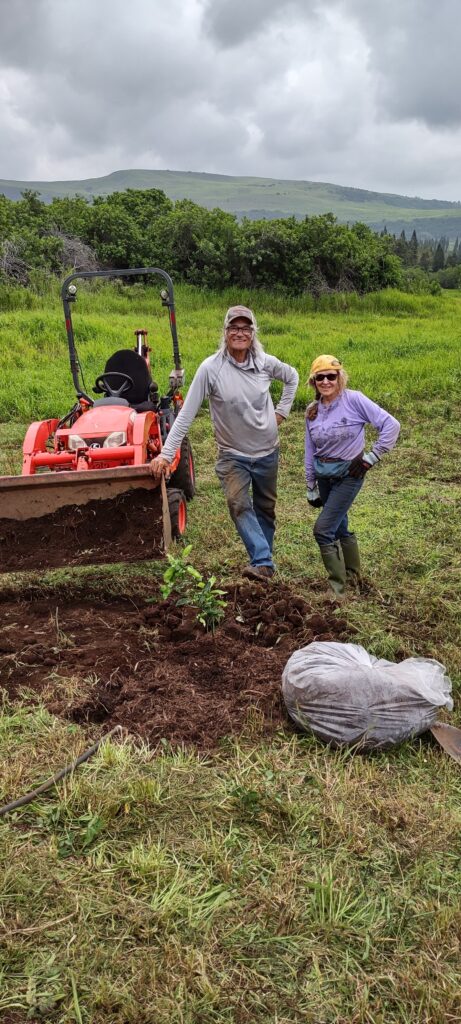
Chelsea Cox of Naalehu with jackfruit tree and her husband and Welsh Corgi—

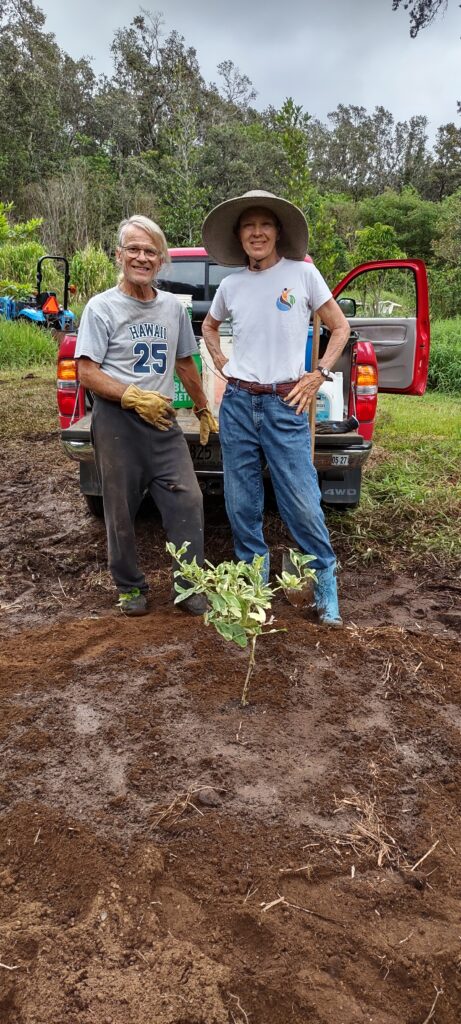
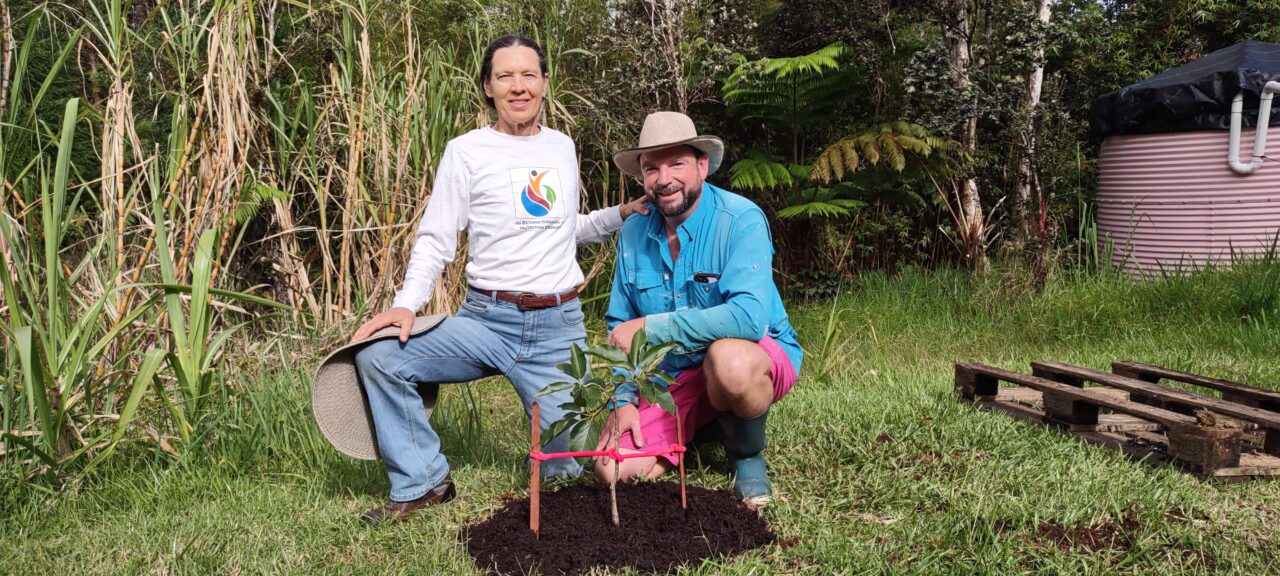
Jim Cocallas (left) of Naalehu with grafted variegated pink lemon tree and Dr. Bogs–
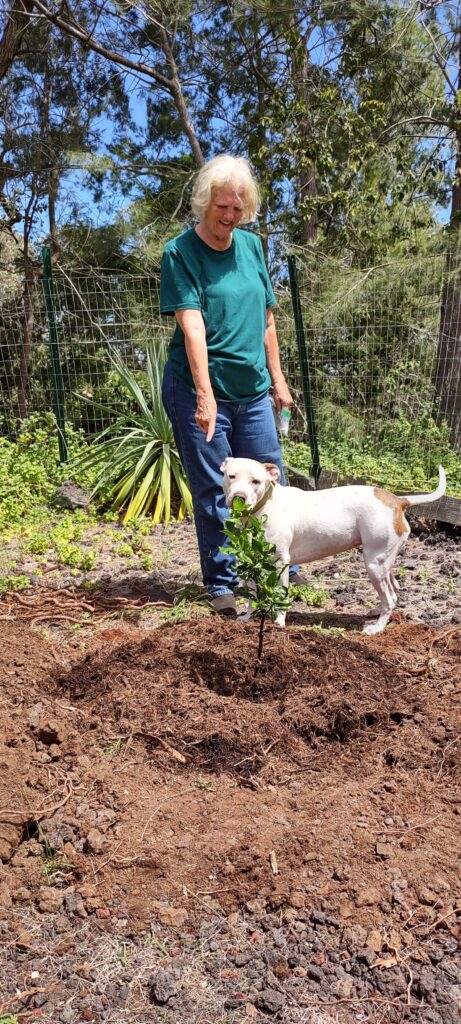
Robin DeArman of Ocean View with grafted Ka’u Gold orange tree and her dog, Cupcake–
Laura Roberts of Ocean View with grafted avocado tree–
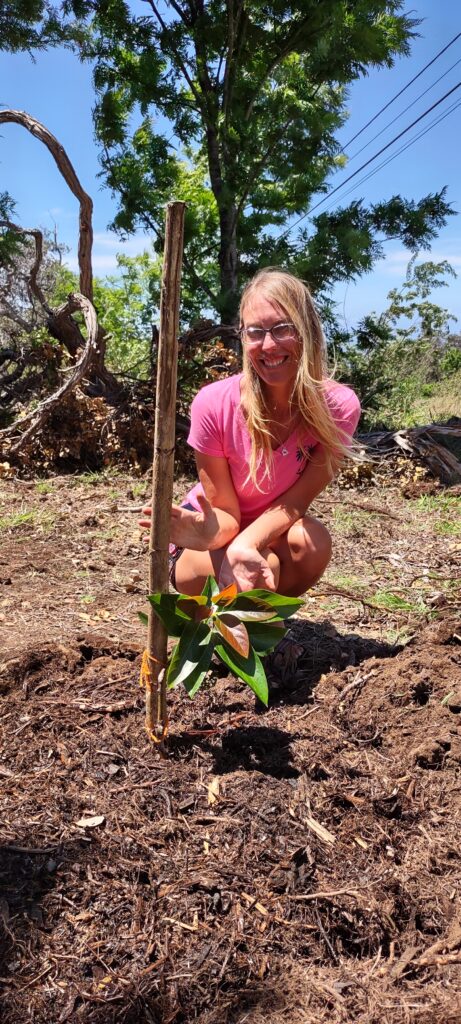
Lorita Kawakami of Ocean View with grafted avocado tree–
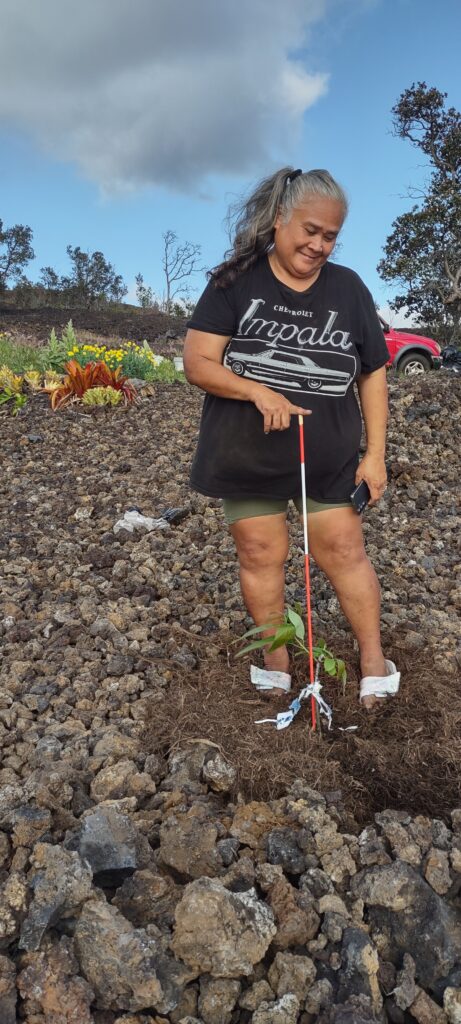
David Unger (mixing fertilizers in soil) of Ocean View Ranchos planting grafted Ka’u Gold orange tree with help from George Perry and tractor–

Kahualani Aitken of South Kona with grafted lemon tree–
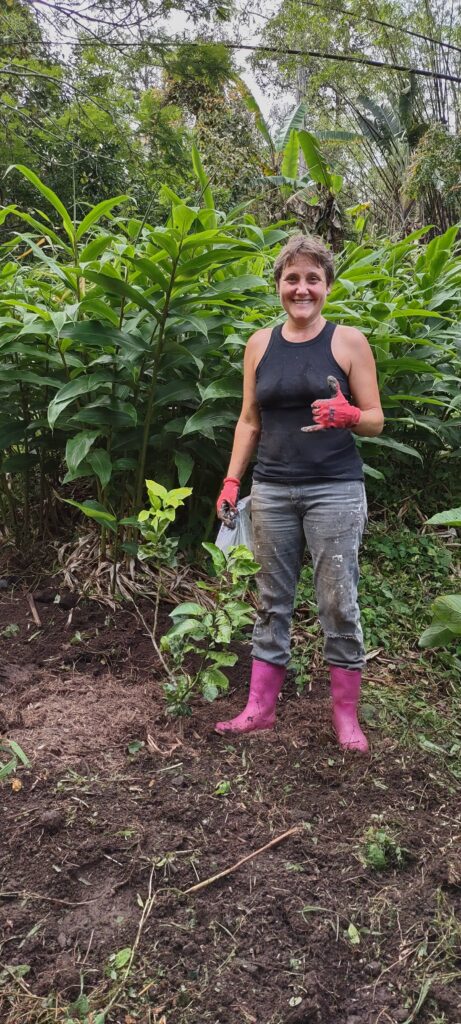
Shawn James-Leavey of Volcano with grafted Linda avocado tree and Dr. Bogs–
Food Trees Program Impact and accomplishments:
Every grower was given an evaluation form at the end of the program. Growers indicated that they enjoyed the course, learned a lot, found the information very useful, and found the soil mineral and soil microbiology analyses very helpful. Most growers indicated that the information was presented clearly, that they plan to apply the info, that the Zoom calls were helpful, and that they liked the Beyond Organic e-book.
When asked, “How is your tree planted during the Food Trees Project program progressing?”, here’s what participants wrote:
“Very well, it has been putting out new growth and looking very healthy.” ==Chelsea
“It’s doing great and growing new leaves.” –Laura
“Doing well! Treated for the avocado lace bug with neem oil. We appreciate the opportunity to expand our orchard with more actionable soil intelligence and beyond organic practices.” —Shawn
“Beautiful! New leaves and very healthy.” –Kahualani
“Doing well. [It] did not stress when it was transplanted.” –Robin
“Doing great with instant new growth.” –Tami
Some additional comments from the participants about the Food Trees Project:
From Shawn—”Dr Jana Bogs and Beyond Organics Consulting transformed our household orchard through soil-food-web analysis and the addition of a Linda Avocado. Her expertise and program management, supported by funding for grassroots food systems, are invaluable! Mahalo Dr Bogs”
From Jim—“I’m very grateful for Jana’s support and persistence in getting my tree in the ground with the amendments and soil, as I had less than optimal sites to plant the tree. It was wonderful to get a tree and have the tractor person come a dig holes. Your wisdom and experience in teaching this class is extremely valuable to our community. I will keep the information for future reference and further study.”
From Chelsea—” I truly appreciate the Food Trees Project and the impact it has had on our community. Receiving fruit trees has been so much more than just getting plants—it has been an investment in our family’s future and in local food security. The project empowers people to grow their own healthy food, learn valuable skills, and become more self-sufficient.
The generosity, knowledge, and encouragement behind the Food Trees Project make it clear that this is about building stronger, healthier communities for generations to come. Every tree planted is a step toward a more sustainable future, providing fresh food, reducing food costs, and strengthening our connection to the land.
As someone who values growing food and sharing it with others, I have seen firsthand how meaningful this project is. I wholeheartedly support the Food Trees Project and hope it continues to receive the funding needed to expand its reach. The positive impact on families, neighborhoods, and our local food system is truly immeasurable.”
From Laura—“I learned a lot about nutrition and plant growing. It was really great to have someone come dig a hole and bring in soil to plant a tree.”
From Lorita—”Yes, I did [enjoy participating]. It was wonderful and I enjoyed learning about the various elements and microbes, etc. that make the difference between a successfully grown tree vs one without the necessary nutrients that make the difference since a lot of soil is nutrient deficient.”
From Robin—”Giving people the knowledge and tools to become food self-sufficient is one of the most important activities we can endeavor. Encouraging people to try gardening and forestry. A successful start will encourage newcomers. neighbors and friends.”
From Tami—” I deeply believe food production and soil amendment is of great importance to benefit all.”
From Kahualani–“I have seen firsthand how access to edible plants and practical knowledge inspires hope and pride within the community. The project brings people together, encourages stewardship of Hawaiʻi’s natural resources, and promotes a culture of mālama ʻāina and mutual support. It demonstrates that small actions such as planting a tree, sharing knowledge, caring for the land, can create meaningful and lasting change. Continued funding for the Food Trees Project will allow this important work to reach more families, expand educational opportunities, and cultivate a healthier, more resilient future for our island communities. I wholeheartedly support its mission and believe it is a worthy investment in both people and place.”
Future plans:
This was the second cohort of growers in the Food Trees Project. Additional grant funding has been applied for. Our long-term plans are to continue reaching out to help community members grow more and better quality foods, with possible expansion to other areas of the Big Island.
Recent Comments